
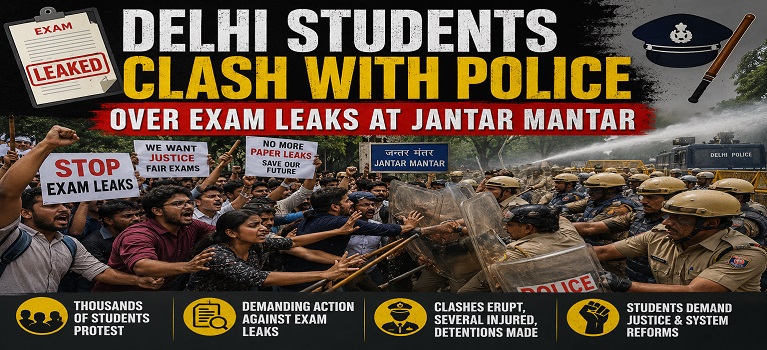
India witnessed one of its most significant student protests in recent years as thousands of students gathered at Jantar Mantar, New Delhi, demanding accountability over repeated examination paper leaks and alleged irregularities in competitive examinations. The demonstrations escalated when protesters attempting to march toward Parliament clashed with Delhi Police, resulting in injuries, detentions, and nationwide attention.
The movement reflects growing frustration among students who spend years preparing for highly competitive examinations, only to see allegations of paper leaks, exam cancellations, and delays affecting their careers.
This article explains the background of the protests, the demands raised by students, the government’s response, the role of law enforcement, and the broader implications for India’s education system.
Why Did Students Protest?
India conducts several large-scale competitive examinations every year for admissions into medical colleges, engineering institutes, universities, and government jobs.
In recent years, multiple examinations have faced allegations of:
- Question paper leaks
- Recruitment irregularities
- Delayed examination schedules
- Cancellation of examinations
- Lack of transparency
- Delayed investigations
Student organizations argue that repeated controversies have damaged trust in public examinations and created uncertainty for millions of aspirants.
Why Jantar Mantar Became the Center of the Protest
Jantar Mantar has historically served as one of Delhi’s principal locations for peaceful demonstrations.
Students, youth groups, and civil society organizations assembled there to demand:
- Transparent investigations into alleged exam leaks
- Faster action against those responsible
- Stronger safeguards against future irregularities
- Accountability from authorities overseeing examinations
The gathering expanded rapidly as participants from several states joined the protest.
What Happened During the Protest?
As demonstrations intensified, some protesters attempted to march toward Parliament despite restrictions imposed by authorities.
Delhi Police erected barricades and asked protesters to remain within the designated protest area.
When groups attempted to move beyond permitted zones, clashes occurred.
Reports indicate that police used crowd-control measures, including batons and tear gas, while protesters alleged excessive force. Authorities, on the other hand, stated that some demonstrators became aggressive, damaged public property, and attempted to breach security arrangements.
Police Response
Delhi Police stated that:
- Necessary restrictions were already in place.
- Protesters attempted to violate security arrangements.
- Crowd-control measures were taken to maintain law and order.
- Several individuals were detained during the demonstration.
Authorities later registered cases relating to the violence and continued investigating the incidents surrounding the protest.
Students’ Allegations
Many students claimed:
- Police used disproportionate force.
- Peaceful demonstrators were lathi-charged.
- Women protesters were also affected during the confrontation.
- The administration failed to adequately address long-standing concerns regarding examination integrity.
Several videos circulated on social media showing confrontations between protesters and police, although competing narratives emerged regarding how the violence began.
Government’s Response
The Union Government maintained that steps had already been initiated to investigate examination irregularities.
Officials highlighted actions such as:
- Arrests connected to alleged paper leak investigations.
- Re-examinations where necessary.
- Ongoing reforms intended to strengthen examination security.
Prime Minister Narendra Modi also stated that action was being taken against those responsible, while government representatives urged students to maintain peace.
Why Examination Paper Leaks Create Such Anger
Competitive examinations often determine a student’s academic or professional future.
Many aspirants spend:
- Several years preparing.
- Significant financial resources on coaching.
- Long hours studying full-time.
When an examination is cancelled or questioned due to alleged malpractice, candidates may lose:
- One academic year.
- Employment opportunities.
- Financial investments.
- Emotional confidence.
This explains why examination controversies frequently lead to nationwide protests.
Impact on Students
Repeated examination controversies affect students in several ways.
Academic Impact
Students may need to:
- Prepare again.
- Reappear for examinations.
- Delay admissions.
Financial Impact
Families often spend:
- Coaching fees
- Hostel expenses
- Travel costs
- Study material expenses
Any cancellation increases these costs.
Mental Health Impact
Students frequently report:
- Stress
- Anxiety
- Depression
- Uncertainty about careers
Education experts have repeatedly emphasized the importance of predictable and transparent examination systems.
Why Trust in Competitive Exams Matters
India conducts examinations involving millions of candidates annually.
A credible examination system depends upon:
- Confidential question papers
- Secure digital systems
- Strong monitoring
- Independent investigations
- Timely communication
When candidates lose confidence, the legitimacy of the examination process itself comes under scrutiny.
Calls for Education Reforms
Many education experts believe reforms should include:
Better Digital Security
Encrypted question paper transmission.
Stronger Monitoring
Real-time surveillance of examination centers.
Faster Investigations
Dedicated agencies investigating exam-related crimes.
Strict Punishments
Severe penalties against paper leak networks.
Transparent Communication
Regular public updates whenever irregularities occur.
Role of Social Media
Social media played a significant role during the demonstrations.
Students used platforms such as X, Instagram, and YouTube to:
- Share updates.
- Upload protest videos.
- Organize demonstrations.
- Raise awareness regarding examination issues.
Hashtags related to examination reforms quickly gained traction across India.
Opposition Reaction
Several opposition leaders criticized the government’s handling of both the examination controversies and the police response.
Political leaders demanded:
- Independent investigations.
- Greater accountability.
- Protection of peaceful protests.
Meanwhile, the government maintained that political groups were attempting to exploit student grievances for broader political purposes.
Legal Perspective
Under Indian law:
- Citizens have the right to peaceful protest.
- Authorities may impose reasonable restrictions in sensitive areas.
- Police are responsible for maintaining public order.
Whenever confrontations occur, investigations generally examine whether both protesters and law enforcement acted within legal limits.
What Students Want
The primary demands emerging from the demonstrations include:
- Transparent investigations into alleged paper leaks.
- Time-bound action against those responsible.
- Stronger examination security.
- Fair opportunities for all candidates.
- Greater accountability from examination authorities.
Long-Term Implications
The protests could influence future examination reforms by encouraging:
- Improved cybersecurity.
- Stronger examination monitoring.
- More transparent recruitment processes.
- Legislative reforms targeting organized examination fraud.
Whether these changes occur will depend on future policy decisions and implementation.
Conclusion
The clashes at Jantar Mantar highlight growing concern among India’s youth regarding the integrity of competitive examinations. For millions of students, examinations represent years of preparation and aspirations for higher education or public employment.
While authorities emphasize law and order and ongoing investigations, students continue to demand greater transparency, accountability, and systemic reforms.
As India expands its education and recruitment systems, strengthening examination integrity will remain essential to maintaining public trust and ensuring that merit—not malpractice—determines success.
Frequently Asked Questions (FAQs)
1. Why did students protest at Jantar Mantar?
Students protested over alleged examination paper leaks, recruitment irregularities, and demands for greater transparency in competitive examinations.
2. Why did clashes occur between students and police?
Clashes occurred when protesters attempted to march toward Parliament despite restrictions, leading police to intervene using crowd-control measures.
3. What were the main demands of the protesters?
Students demanded transparent investigations, accountability, stronger examination security, and reforms to prevent future paper leaks.
4. What did the government say?
The government stated that investigations and arrests had already been initiated and that reforms were being implemented to improve examination integrity.
5. Did Delhi Police make arrests?
Yes. Police detained several protesters and registered cases related to the demonstrations.
6. Why are paper leaks a major concern?
Paper leaks undermine merit, force re-examinations, delay admissions and recruitment, and impose financial and emotional costs on students.
7. What reforms are students seeking?
Students want stronger digital security, faster investigations, tougher penalties for exam fraud, and more transparent examination processes.
8. Where did the protest take place?
The main protest was held at Jantar Mantar in New Delhi, a traditional venue for public demonstrations.
9. How many students are affected by examination irregularities?
Major national entrance and recruitment examinations collectively involve millions of candidates each year, making any disruption significant.
10. What happens next?
The return to normalcy depends on the outcome of ongoing investigations, any announced reforms, and continued dialogue between authorities and student representatives.