
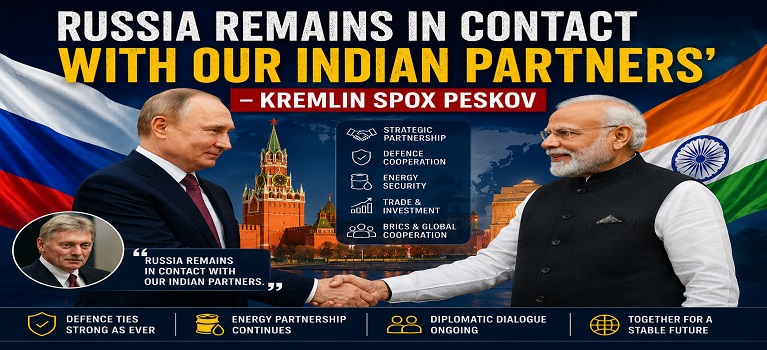
Russia has reaffirmed its commitment to maintaining close communication with India, with Kremlin spokesperson Dmitry Peskov stating that Russia remains in regular contact with its Indian partners. The statement comes at a time when global geopolitical tensions continue to reshape international alliances, energy markets, defence cooperation, and diplomatic priorities.
India and Russia have shared a strategic partnership for more than seven decades. Despite changing global political dynamics, sanctions on Russia, and India’s growing engagement with Western nations, both countries continue to maintain strong diplomatic, economic, and defence ties.
Peskov’s latest statement highlights Moscow’s intention to preserve this long-standing relationship while addressing emerging global challenges through dialogue and cooperation.
Why Did the Kremlin Make This Statement?
Kremlin spokesperson Dmitry Peskov’s remarks come amid increasing international attention on Russia’s diplomatic engagements with major global partners, particularly India.
The statement signals several important messages:
- Russia values India as a strategic partner.
- Diplomatic communication between both countries remains active.
- Bilateral cooperation continues despite global geopolitical pressures.
- Moscow seeks continuity in trade, defence, and energy cooperation.
Rather than indicating a new policy shift, the statement reinforces Russia’s consistent diplomatic position regarding India.
India-Russia Relations: A Partnership Built Over Decades
India and Russia have maintained close ties since the Cold War era.
Their relationship has evolved into a Special and Privileged Strategic Partnership, covering multiple sectors including:
- Defence
- Energy
- Nuclear cooperation
- Space technology
- Trade
- Pharmaceuticals
- Infrastructure
- Education
- Science & Technology
Unlike many bilateral relationships based primarily on economics, India-Russia relations are built on decades of political trust and strategic cooperation.
Defence Cooperation Remains a Key Pillar
One of the strongest aspects of India-Russia relations continues to be defence collaboration.
Russia has been India’s largest defence supplier for several decades.
Major defence projects include:
- S-400 Air Defence System
- BrahMos Supersonic Cruise Missile
- Sukhoi Su-30MKI fighter aircraft
- T-90 battle tanks
- INS Vikramaditya aircraft carrier
- Nuclear submarine cooperation
Even as India diversifies defence procurement by purchasing equipment from France, Israel, and the United States, Russian platforms continue to constitute a significant portion of India’s military inventory.
Regular communication between officials helps ensure smooth implementation of these projects.
Energy Partnership Continues to Expand
Since 2022, India has become one of the largest buyers of Russian crude oil.
Following Western sanctions on Moscow, India significantly increased imports of discounted Russian crude.
This has benefited India by:
- Lowering import costs
- Supporting domestic fuel stability
- Diversifying energy sources
- Strengthening energy security
Russia has consistently described India as a reliable energy partner.
Peskov’s statement further indicates that energy cooperation remains an important area of engagement.
Trade Between India and Russia
Trade between the two countries has witnessed substantial growth in recent years.
Major Indian imports from Russia include:
- Crude oil
- Fertilizers
- Coal
- Precious metals
- Machinery
Indian exports to Russia include:
- Pharmaceuticals
- Tea
- Coffee
- Agricultural products
- Engineering goods
- Chemicals
- Textiles
Both governments are working toward expanding bilateral trade and reducing dependence on the US dollar through alternative payment mechanisms.
The Importance of BRICS
India and Russia are founding members of BRICS.
The organization has become increasingly important as emerging economies seek greater representation in global governance.
BRICS cooperation focuses on:
- Economic development
- Infrastructure financing
- Digital economy
- Trade
- Climate cooperation
- Financial reforms
Regular diplomatic consultations between India and Russia help strengthen coordination within BRICS.
Cooperation Within the Shanghai Cooperation Organisation (SCO)
Both nations also work closely under the Shanghai Cooperation Organisation.
The SCO promotes cooperation in:
- Counter-terrorism
- Regional security
- Economic cooperation
- Connectivity
- Cultural exchanges
India and Russia often coordinate positions during SCO meetings on regional security matters.
Nuclear Energy Collaboration
Civil nuclear cooperation remains another major area.
Russia has played a leading role in developing India’s nuclear power capacity.
The Kudankulam Nuclear Power Plant in Tamil Nadu stands as one of the most successful examples of India-Russia cooperation.
Future expansion projects continue under bilateral agreements.
Space Cooperation
India and Russia have collaborated in space exploration for decades.
Areas of cooperation include:
- Satellite technology
- Human spaceflight
- Space research
- Navigation systems
- Launch technologies
The partnership continues to evolve alongside India’s expanding space ambitions.
Why India Maintains Balanced Foreign Policy
India follows a policy known as strategic autonomy.
Instead of aligning exclusively with any one geopolitical bloc, India maintains relations with:
- Russia
- United States
- European Union
- Japan
- Australia
- ASEAN countries
- Middle Eastern nations
This balanced approach enables India to protect its national interests while engaging constructively with multiple global partners.
Russia has repeatedly acknowledged India’s independent foreign policy.
Western Pressure and India’s Position
Since the Ukraine conflict began, several Western countries have encouraged India to reduce economic engagement with Russia.
India has maintained that:
- National interest guides foreign policy.
- Energy security remains a priority.
- Diplomatic dialogue is essential.
- Peaceful resolution should be pursued.
The Kremlin’s statement underscores that bilateral engagement continues despite these external pressures.
Diplomatic Communication Is Normal
Peskov’s remark that Russia remains in contact with Indian partners reflects standard diplomatic practice.
Countries maintain communication for several reasons:
- Monitoring international developments
- Coordinating high-level visits
- Managing trade relations
- Discussing defence cooperation
- Addressing regional security
- Preparing multilateral summits
Such communication does not necessarily indicate any immediate policy announcement.
Economic Opportunities Ahead
Experts believe India-Russia cooperation could expand in several sectors:
Renewable Energy
Joint investments in clean energy technologies may increase.
Pharmaceuticals
Indian pharmaceutical exports to Russia continue growing.
Information Technology
Digital transformation offers new opportunities for collaboration.
Infrastructure
Large-scale infrastructure projects may receive additional investment.
Agriculture
Food security cooperation has gained importance in recent years.
Challenges Facing the Partnership
Despite strong ties, several challenges remain.
Payment Mechanisms
International sanctions have complicated financial transactions.
Logistics
Shipping routes require optimization.
Trade Imbalance
India imports significantly more from Russia than it exports.
Sanctions
Global sanctions create uncertainty for businesses.
Diversification
India is expanding partnerships globally while preserving traditional relationships.
Global Significance of India-Russia Relations
India’s relationship with Russia has implications beyond bilateral ties.
It influences:
- Asian security
- Global energy markets
- BRICS cooperation
- International diplomacy
- Defence industry
- Multilateral institutions
As geopolitical competition intensifies, India’s balanced diplomacy continues to attract global attention.
What Experts Say
Foreign policy analysts generally agree that India and Russia are likely to continue engaging across strategic sectors despite changing international circumstances.
The relationship is increasingly becoming more pragmatic, focusing on mutual economic and security interests rather than ideological alignment.
Experts also note that regular diplomatic communication helps maintain stability during periods of global uncertainty.
Looking Ahead
The Kremlin’s statement indicates continuity rather than change.
India and Russia are expected to continue cooperation in:
- Defence
- Energy
- Trade
- Nuclear power
- Space technology
- Multilateral forums including BRICS and SCO
While global geopolitical dynamics continue evolving, both countries appear committed to maintaining regular dialogue and expanding areas of mutual benefit.
Conclusion
Kremlin spokesperson Dmitry Peskov’s statement that Russia remains in contact with its Indian partners reinforces the enduring nature of India-Russia relations. The two nations continue to engage across defence, energy, trade, diplomacy, and multilateral platforms despite global geopolitical shifts.
For India, maintaining strategic autonomy while strengthening partnerships with multiple global powers remains central to its foreign policy. For Russia, India continues to be one of its most important partners in Asia. As both countries navigate an increasingly complex international environment, sustained dialogue and cooperation are expected to remain the foundation of this long-standing partnership.
Frequently Asked Questions (FAQs)
1. Who is Dmitry Peskov?
Dmitry Peskov is the official spokesperson for the Kremlin and serves as the Press Secretary to the President of Russia.
2. What did the Kremlin say about India?
The Kremlin stated that Russia remains in regular contact with its Indian partners, reaffirming continued diplomatic engagement.
3. Why is this statement important?
It highlights the continued strength of India-Russia relations despite evolving global geopolitical circumstances.
4. Is India still maintaining relations with Russia?
Yes. India continues diplomatic, defence, trade, and energy cooperation with Russia while also engaging with other global partners.
5. What sectors define India-Russia cooperation?
Major sectors include defence, energy, nuclear power, pharmaceuticals, space technology, trade, education, and science.
6. Is India buying Russian oil?
Yes. India has significantly increased imports of Russian crude oil in recent years, driven by energy security and competitive pricing.
7. Are India and Russia members of BRICS?
Yes. Both countries are founding members of BRICS and actively cooperate within the grouping.
8. Does this statement indicate a new agreement?
No. The statement primarily reaffirms ongoing diplomatic communication and does not by itself announce a new bilateral agreement.
9. How does India balance relations with Russia and Western countries?
India follows a policy of strategic autonomy, maintaining independent relations with Russia, the United States, Europe, and other global partners based on national interests.
10. What is the future of India-Russia relations?
Analysts expect continued cooperation in defence, energy, trade, technology, and multilateral forums while both countries adapt to changing global dynamics.