
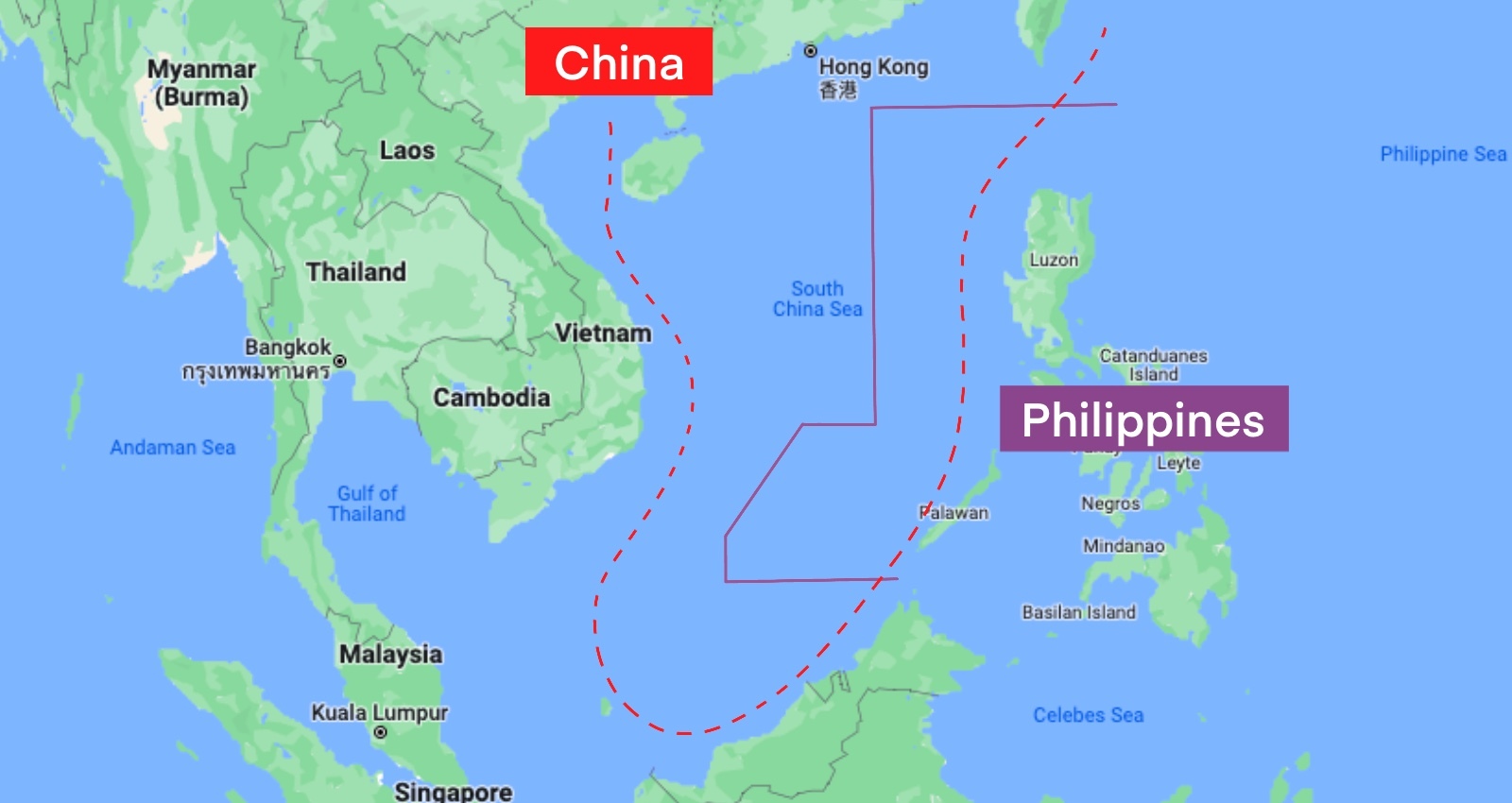
The South China Sea, a critical waterway through which trillions of dollars in trade pass annually, has been at the center of geopolitical tensions for decades due to China’s expansive territorial claims. China asserts sovereignty over nearly 90% of this sea, encapsulated by the contentious “nine-dash line,” a demarcation that extends to waters claimed by Vietnam, the Philippines, Malaysia, Brunei, and Taiwan.
Historically, China’s claims to the South China Sea can be traced back to the Han Dynasty (206 BCE – 220 CE), where records show Chinese fishing and exploration activities in the region. However, the modern legal basis of these claims was formalized in 1947 by the Republic of China with an eleven-dash line map, later modified to nine dashes by the People’s Republic of China in 1953, dropping claims in the Gulf of Tonkin.
China’s narrative of historical rights was challenged in 2016 when the Permanent Court of Arbitration in The Hague ruled in favor of the Philippines in a case against China’s maritime claims. The tribunal determined that China’s nine-dash line claim had no legal basis under the United Nations Convention on the Law of the Sea (UNCLOS), to which China is a signatory. Despite this ruling, China rejected the decision, maintaining that its historical rights supersede the convention’s provisions.
China’s actions in the South China Sea have included significant land reclamation efforts, creating artificial islands equipped with military installations, thereby asserting control over these waters. These activities, combined with aggressive maritime patrols, have led to numerous confrontations with neighboring countries, escalating tensions in the region.
The U.S., not a signatory to UNCLOS but advocating for freedom of navigation, has conducted “freedom of navigation operations” (FONOPs) to challenge what it perceives as excessive maritime claims by China. This has further internationalized the issue, drawing in other global powers concerned about the strategic and economic implications of China’s maritime strategy.
The South China Sea dispute continues to be a flashpoint, with implications for international law, maritime security, and the balance of power in Asia. The claims, steeped in historical assertions and countered by international legal perspectives, represent a complex challenge to regional stability, with no immediate resolution in sight as China continues to assert its dominance in these vital waters.
Frequently Asked Questions
What are China’s claims in the South China Sea?
China claims vast areas of the South China Sea based on the Nine-Dash Line, overlapping with other regional claims.
What is the Nine-Dash Line?
The Nine-Dash Line is China’s assertion of historical rights over much of the South China Sea, despite lacking legal recognition.
Which countries are affected by China’s South China Sea claims?
Vietnam, the Philippines, Malaysia, Brunei, and Indonesia are among the affected countries.
Why is the South China Sea strategically important?
It is vital for global trade routes, energy resources, fisheries, and military positioning.
What did the 2016 PCA ruling state?
The ruling found that China’s claims under the Nine-Dash Line have no legal basis under UNCLOS.
How has China responded to the PCA ruling?
China rejected the ruling and continued activities such as militarization and patrols.
What role does UNCLOS play in the dispute?
UNCLOS defines maritime rights and boundaries, forming the legal basis for resolving disputes.
How does China enforce its claims?
China uses naval forces, coast guard patrols, maritime militia, and artificial islands.
What are the security implications of the dispute?
The dispute raises tensions and challenges regional stability and international law.
How has the international community responded?
Many countries oppose China’s claims and support freedom of navigation and legal norms.