
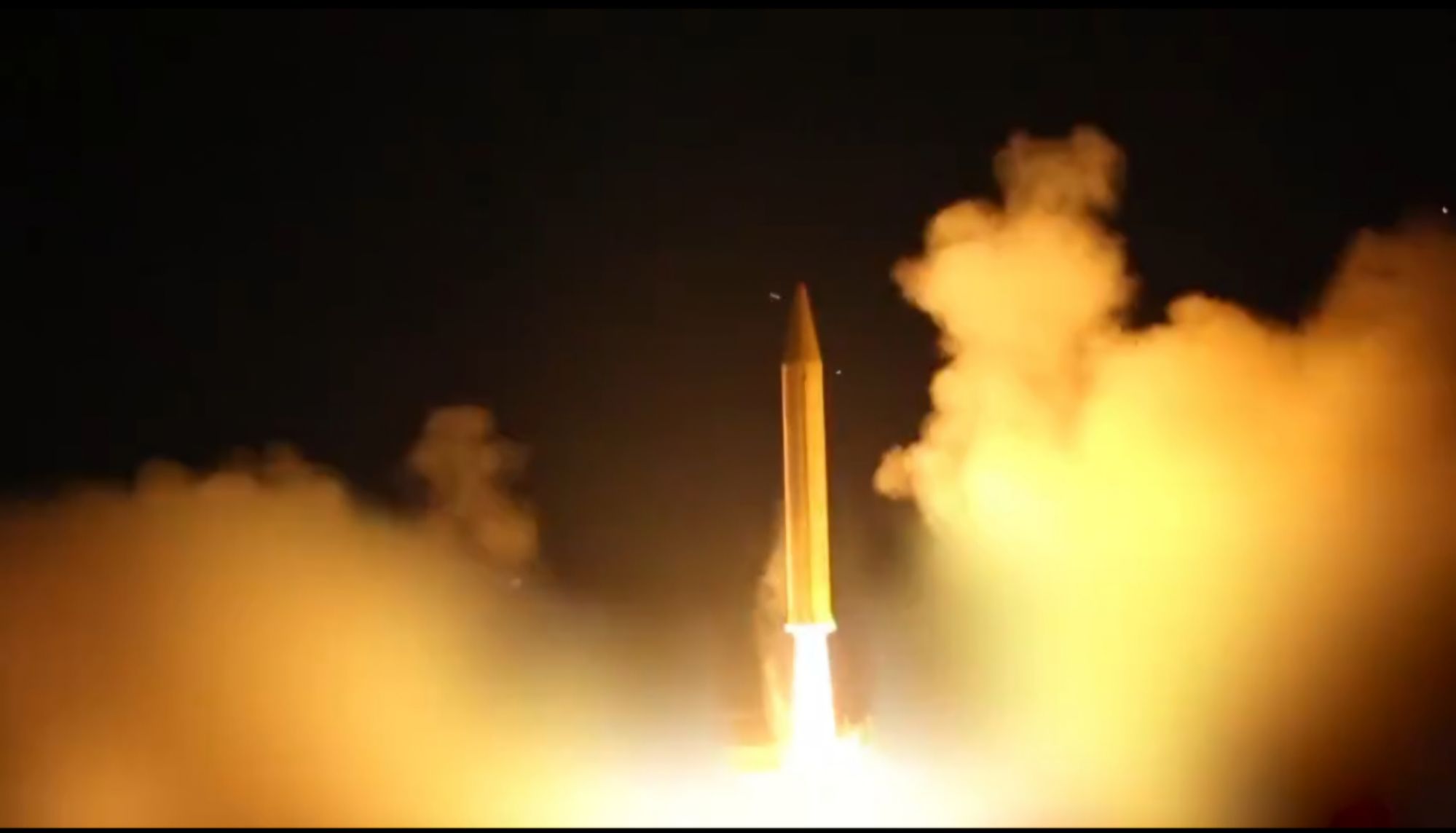

Iran’s Islamic Revolutionary Guard Corps (IRGC) launched a Khorramshahr-4 ballistic missile toward Israeli territory early Thursday, state media reported, marking a significant escalation in the intensifying conflict between Iran, Israel, and the United States that has gripped the Middle East since late February.The strike, described by Iranian sources as retaliation for ongoing US-Israeli airstrikes on Iranian military and nuclear-related sites, targeted positions in central Israel, including areas near Tel Aviv and Ben Gurion Airport, according to IRGC statements carried by Fars News Agency and other state outlets.
The missile, equipped with a one-ton (approximately 1,000 kg) warhead and an estimated range of 2,000 kilometers (1,240 miles), was launched at dawn, with video footage released by Iranian media showing its nighttime ignition and rapid ascent.Iranian officials claimed the advanced liquid-fueled missile, also referred to as Kheibar in some designations, demonstrated superior capabilities, including the potential to carry cluster munitions designed to overwhelm air defense systems. They asserted it evaded multiple layers of Israeli interception, though these claims remained unverified by independent sources as of early Thursday afternoon local time in Israel.
The Israeli military confirmed detecting incoming ballistic missiles from Iran and activated nationwide air defense systems, including the Arrow and David’s Sling interceptors, supported by US assets in the region. Sirens sounded across central Israel, forcing millions into shelters. Initial reports indicated some impacts in the Tel Aviv area and injuries, but no immediate confirmation of widespread destruction or fatalities from the specific Khorramshahr-4 launch. Israeli officials have not yet provided a detailed battle damage assessment.
The Khorramshahr-4, unveiled publicly in February 2026 at an underground IRGC “missile city” facility, represents one of Iran’s most potent medium-range ballistic missiles. Powered by the Arvand engine using hypergolic fuels for quicker launch readiness, it builds on earlier variants and was first reportedly used in combat during the brief but intense 12-day Israel-Iran war in June 2025. That earlier conflict erupted after US strikes on Iranian nuclear facilities, prompting Iranian retaliatory barrages that included heavy-payload missiles.
Thursday’s launch comes amid a broader campaign that began escalating dramatically in late February 2026, when combined US-Israeli airstrikes targeted Iranian ballistic missile launchers, nuclear infrastructure, and senior military figures. The operation, described by US and Israeli leaders as aimed at degrading Iran’s missile program and preventing further attacks, has seen hundreds of sorties and the destruction of numerous launchers, according to Israeli assessments. Iran has responded with repeated waves of ballistic missiles and drones, though at a reduced tempo compared to the initial days. Reports indicate cluster munition warheads have been used in prior barrages, causing civilian injuries in Israeli cities. The conflict has already claimed hundreds of lives on both sides, with significant damage to infrastructure in Iran and scattered impacts in Israel.The United States has provided defensive support to Israel while conducting its own strikes, heightening fears of a wider regional war involving proxies in Lebanon, Yemen, and Iraq. Diplomatic efforts to de-escalate have stalled, with both sides vowing continued operations.
Frequently Asked Questions (FAQs)
What is the Khorramshahr-4 missile launched by Iran?
The Khorramshahr-4, also known as the Kheibar missile, is an advanced Iranian ballistic missile capable of long-range strikes with a payload of up to 1,500 kg and a range of about 2,000 km.
Why did Iran launch the Khorramshahr-4 missile toward Israel?
The launch occurred amid rising tensions between Iran and Israel and reflects ongoing regional military and geopolitical confrontations.
What makes the Khorramshahr-4 missile significant?
It is considered one of Iran’s most powerful missiles due to its large payload capacity, improved guidance systems, and long operational range.
What is the range of the Khorramshahr-4 missile?
The missile can reportedly travel up to approximately 2,000 kilometers (1,240 miles).
What type of fuel does the Khorramshahr-4 missile use?
The missile uses liquid fuel, which supports heavy payload capacity but requires more preparation before launch.
How did Israel respond to the missile launch?
Israel relies on layered missile defense systems such as Arrow, David’s Sling, and Iron Dome to intercept ballistic missile threats.
What are the broader implications of this missile launch?
The event signals heightened regional tensions and raises concerns about further escalation in the Middle East.
Is the Khorramshahr-4 part of Iran’s broader missile program?
Yes, it is part of Iran’s ongoing effort to develop long-range ballistic missile capabilities.