

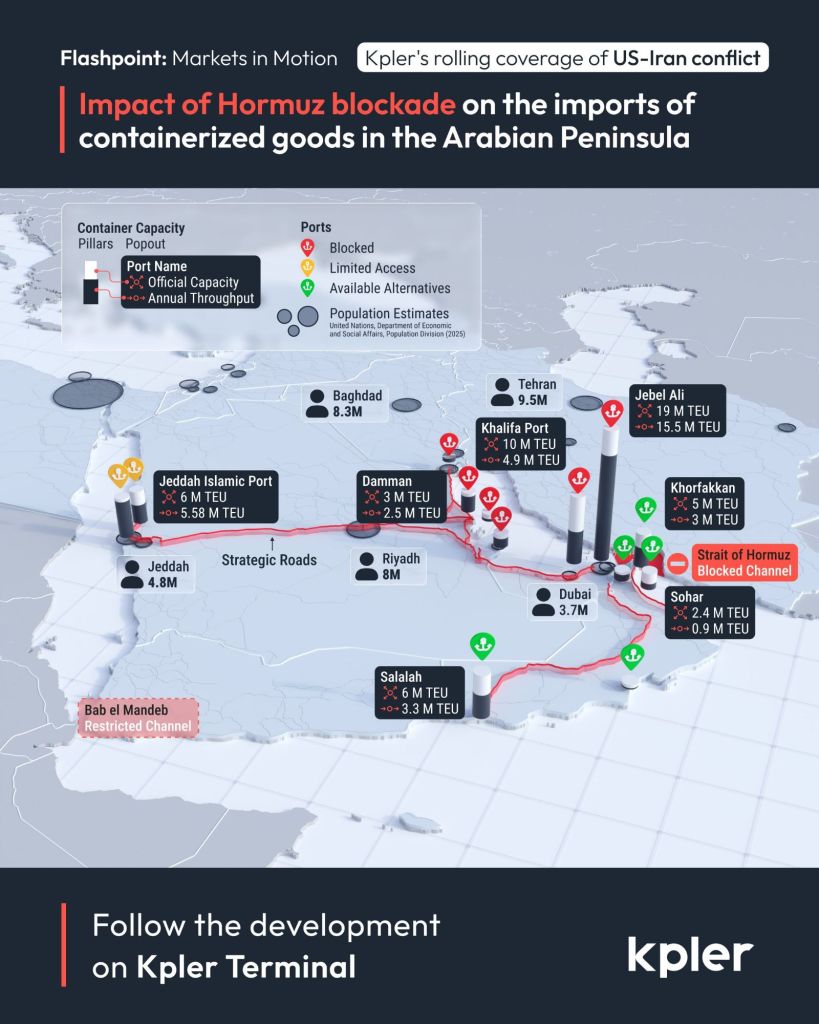
The narrow Strait of Hormuz, a lifeline for about one-fifth of the world’s daily oil and a big chunk of liquefied natural gas, has turned into a ghost lane. Tankers and container ships that once streamed through nonstop are now either anchored in huge clusters, making desperate U-turns, or rerouting thousands of miles around Africa. Real-time maps from MarineTraffic look almost empty compared to just a couple of weeks ago. The numbers present a stark picture.
Container traffic through the strait has collapsed by roughly 94% from early February to March 5. Tanker flows have fared even worse—down 80-95% in many counts, with some days showing almost nothing moving. At least 37 containerships sit trapped inside the Persian Gulf, another 16 hover just outside waiting for any kind of green light, and more than 40 have already diverted. Big names like CMA CGM (14 vessels hit), MSC (12), Hapag-Lloyd, and Maersk have pulled services or sent ships the long way, tacking weeks onto already strained schedules. This didn’t happen by accident.

After U.S. and Israeli strikes hammered Iranian targets starting late February, Iran has hit back hard. Several missiles have been fired, reportedly damaging at least four or five tankers, some left burning, and civilian crew members killed or injured. The Revolutionary Guard declared the strait off-limits to Western-linked shipping, and insurers withdrew war-risk coverage or raised premiums to such an extent that no one could afford to take the risk. It’s not a formal blockade with mines or warships blocking the channel—it’s a commercial freeze-out driven by pure fear. More than 150 vessels, from crude carriers to LNG ships, are stuck at anchor around the Gulf, some for five days or longer. QatarEnergy has already declared force majeure on certain LNG cargoes, putting supplies to Europe, Asia, and South Asia at immediate risk. Major Asian buyers like China, India, Japan, and South Korea, who suck up most of the Gulf crude, are staring down the barrel. Japan gets 95% of its oil this way; India’s LNG is heavily tied here too. Oil markets are reacting fast. Brent crude has pushed past $83 a barrel, and analysts are openly talking $100–$120 if this drags on a few more weeks. That level could echo the worst of the 1970s shocks.
Diesel in Europe is already up over 40% in spots. Fertilizer prices are spiking too, since a third of global trade normally flows through here, and Qatar’s giant LNG plants feed a lot of that chain. Shipping bosses aren’t taking chances. Rerouting around the Cape adds huge time and fuel costs — supertanker day rates have shot from around $37,000 to $177,000. Those extras get passed straight to consumers eventually. Ports farther out are bracing for congestion as cargo piles up. Iran says the strait isn’t fully closed and some non-Western ships, including at least one Chinese bulk carrier, reportedly slipped through under special clearance. But for most commercial operators, the math doesn’t work. Risk is too high, coverage is gone, and no one wants to be the next target.
Frequently Asked Questions (FAQs)
Why has shipping in the Strait of Hormuz slowed or halted?
Shipping activity has been disrupted due to escalating tensions involving Iran, raising security concerns for commercial vessels transporting oil and other goods.
Why is the Strait of Hormuz important to global energy markets?
The strait is one of the world’s most critical energy chokepoints, with about 20% of global oil supply passing through it each day.
How does conflict with Iran affect oil prices?
Any threat to shipping in the Strait of Hormuz can push oil prices higher because it disrupts global supply chains and creates market uncertainty.
Which countries rely on the Strait of Hormuz for exports?
Major oil producers including Saudi Arabia, Iraq, Kuwait, Qatar, and the United Arab Emirates rely on the strait to export energy to global markets.
What risks do ships face in the Strait of Hormuz during conflict?
Commercial ships may face risks such as naval confrontations, missile attacks, sea mines, and drone strikes during regional conflicts.
Can oil shipments bypass the Strait of Hormuz?
Some countries have pipeline alternatives, but these routes cannot fully replace the large volume of oil transported through the strait.
How could this crisis impact the global economy?
Extended disruption could lead to higher fuel prices, inflation, supply shortages, and economic instability in energy-dependent countries.