

India and the European Union on Monday elevated their strategic partnership to a new level, signing a series of key agreements across trade, mobility, security and clean energy, while committing to accelerate negotiations on a long-pending Free Trade Agreement (FTA) at a high-profile summit hosted by Prime Minister Narendra Modi.
European Commission President Ursula von der Leyen and European Council President António Costa joined Modi in New Delhi for the 16th India–EU Summit, which saw the two sides unveil an expanded roadmap for cooperation in defense, innovation, digital trade and green technologies.

Addressing the joint ceremony, Prime Minister Modi described the partnership as one that extends beyond bilateral interests.
“Our cooperation in technology, clean energy, digital governance and development is not just for India and Europe. It is for the larger good of humanity — whether in healthcare, sustainable agriculture or addressing global challenges,” he said, underlining the summit’s role in building a resilient and future-ready global order.
Calling the day “historic”, European Commission President Ursula von der Leyen said the renewed push on the FTA would be a major economic catalyst.
“The Free Trade Agreement we are negotiating will be truly historic. It has the potential to boost our economies, create jobs and reduce tariffs by up to €4 billion annually, opening access to a market of more than two billion people,” she said, describing the partnership as “transformative and built on trust”.
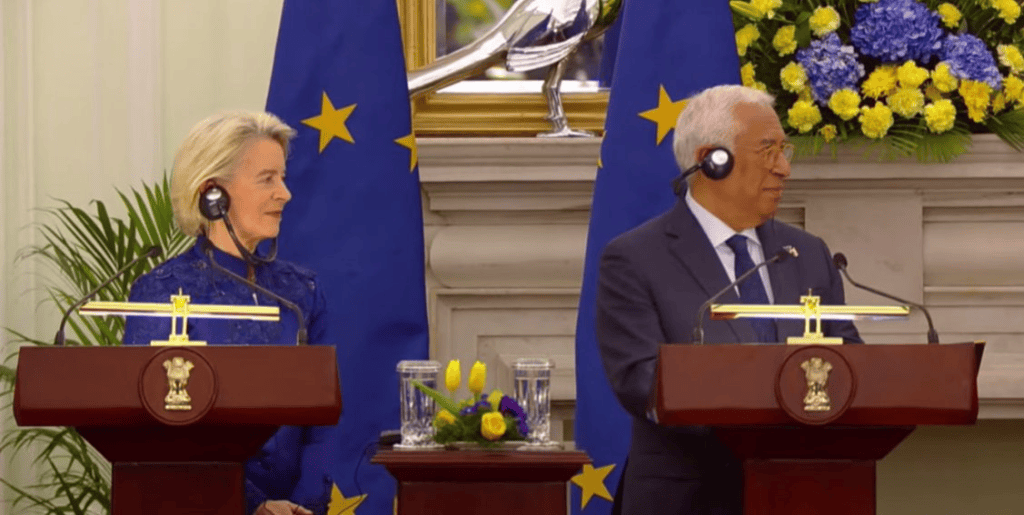
European Council President António Costa said the summit marked “the opening of a new chapter in EU–India relations”.
“Our partnership is forward-looking and indispensable. We are committed to intensifying trade negotiations and deepening cooperation in security and defence, including maritime security and countering hybrid threats,” he said, reiterating the EU’s support for “a comprehensive, just and lasting peace in Ukraine”.
Key Agreements Signed
At the centre of the summit was the signing of a comprehensive framework on cooperation and mobility. The two sides also exchanged:
- An administrative arrangement on disaster risk management
- An agreement establishing a Green Hydrogen Task Force
- A memorandum of understanding between the Reserve Bank of India and the European Securities and Markets Authority
- An arrangement on advanced electronic seals and digital signatures
EU President Ursula van der Leyen announced launching of the first EU legal gateway office in India. It will be a one stop hub to support Indian talent moving to Europe in full alignment with EU Member States needs and policies.
Security and Defence Cooperation Deepens
Signalling a sharper strategic alignment, India and the EU announced the launch of negotiations on a Security of Information Agreement, alongside plans for joint naval exercises to combat piracy and expanded cooperation on cyber and hybrid threats.
A new dedicated dialogue on space security was also announced.
“Our security and defence partnership is stronger than ever — from maritime cooperation to counter-terrorism, we stand shoulder-to-shoulder,” von der Leyen said.
Innovation, Startups and Talent Mobility
The EU reaffirmed its €100-billion commitment under the Horizon Europe programme, paving the way for India’s full association and deeper collaboration in research and innovation.
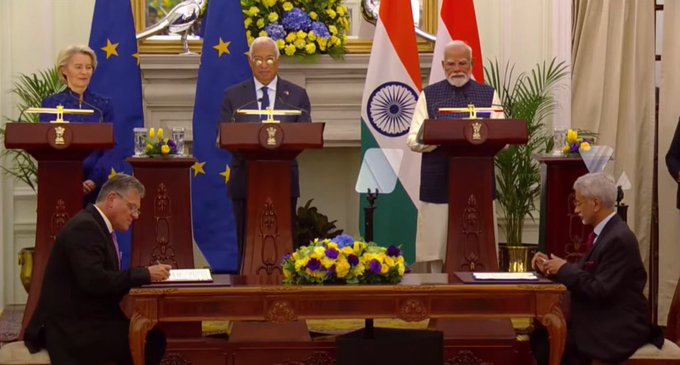
The leaders also announced the launch of an EU–India Startup Partnership and plans to open the first EU Legal Gateway office in India to facilitate skilled talent mobility and regulatory cooperation.
An inaugural EU–India Business Forum was scheduled later in the day to accelerate trade and investment engagement between industry leaders on both sides.
With a strong political push and concrete deliverables, the New Delhi summit has positioned India and the European Union as pivotal partners in a rapidly shifting global landscape — anchored in shared democratic values, economic opportunity and a common vision for a sustainable and secure future.
Frequently Asked Questions
What is the India–EU Strategic Partnership?
The India–EU Strategic Partnership is a long-term framework for cooperation covering politics, trade, security, climate change, and technology.
When was the India–EU Strategic Partnership established?
The partnership was established in 2004 and has expanded through summits and joint action plans.
Why is the India–EU relationship strategically important?
It is important due to shared democratic values, economic complementarities, and common geopolitical concerns.
What are the key areas of cooperation between India and the EU?
Key areas include trade, climate change, clean energy, digital technology, defense, and research.
How does trade feature in India–EU relations?
The EU is one of India’s largest trading partners, and both sides are negotiating a Free Trade Agreement.
What role does climate change play in India–EU ties?
Climate action is central, with cooperation on renewable energy and sustainability initiatives.
How do India and the EU cooperate on global security issues?
They work together on maritime security, counterterrorism, cyber security, and Indo-Pacific stability.
What is the India–EU Connectivity Partnership?
It focuses on sustainable infrastructure, digital connectivity, and transparent financing.
What challenges affect India–EU relations?
Challenges include regulatory differences, trade disputes, and foreign policy divergences.
What is the future outlook for India–EU relations?
The partnership is expected to grow stronger due to converging strategic and economic interests.