
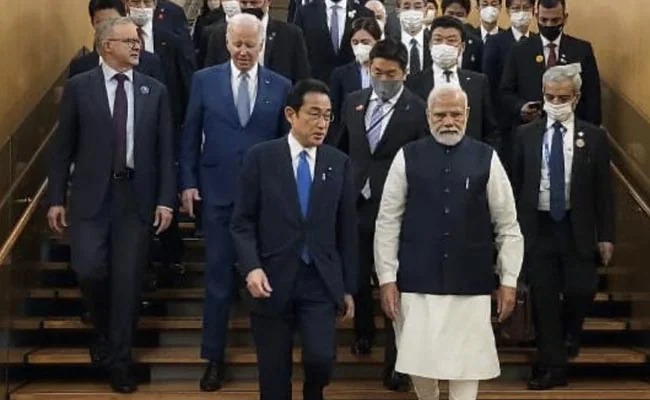
India’s involvement in the Quadrilateral Security Dialogue (QUAD), composed of the United States, Japan, Australia, and India, has significantly evolved over the last decade, reflecting New Delhi’s strategic recalibrations in response to regional security dynamics, particularly vis-à-vis China.

The formal revival of QUAD in 2017 marked a pivotal moment for India. Initially, India had been cautious about joining what was perceived as an anti-China bloc. However, the Doklam standoff with China in 2017, where Indian and Chinese troops were locked in a 73-day face-off in Bhutan, underscored the need for strategic alliances to counterbalance China’s assertiveness in the region. This incident was a catalyst for India to view QUAD not just as a security dialogue but as a platform for broader strategic cooperation.
Since then, India’s engagement with QUAD has deepened, driven by several factors:
Strategic Autonomy and Balance: India has navigated its QUAD involvement with a policy of ‘strategic autonomy’, ensuring that its participation does not exclusively define its foreign policy but complements its broader strategic interests. This includes maintaining a balance between its relations with Russia, a traditional ally, and the Western powers within QUAD.
Maritime Security: Given its vast coastline and strategic location in the Indian Ocean, maritime security is a significant concern for India. QUAD has become a vehicle for enhancing maritime domain awareness, conducting joint naval exercises like the Malabar, and ensuring freedom of navigation in the Indo-Pacific, implicitly countering China’s expansive claims in the South China Sea.
Economic and Technological Collaboration: QUAD has moved beyond a purely security-focused alliance to include economic dialogues, supply chain resilience, and technological partnerships, particularly in areas like 5G, cybersecurity, and critical and emerging technologies. This aligns with India’s ambitions to become a hub for manufacturing and technology, reducing dependency on any single nation, notably China.
Vaccine Diplomacy: During the COVID-19 pandemic, QUAD members collaborated on vaccine distribution, with India playing a pivotal role through its ‘Vaccine Maitri’ initiative, showcasing the group’s capacity for humanitarian cooperation.
Challenges and Critiques: India’s deeper involvement in QUAD has not been without challenges. There’s been domestic and international scrutiny regarding the alliance’s purpose, with some viewing it as an attempt to contain China, potentially drawing India into larger geopolitical conflicts. Moreover, India’s commitment to QUAD sometimes clashes with its non-alignment principles and its strategic partnership with Russia.

The Way Forward: As of 2025, India’s participation in QUAD meetings has been consistent, with Prime Minister Narendra Modi attending both the ministerial and leaders’ summits, emphasizing India’s commitment to a free, open, and inclusive Indo-Pacific. The focus has been on expanding QUAD’s agenda to include climate change, infrastructure development, and counter-terrorism, aligning with India’s broader foreign policy goals.
India’s engagement in QUAD signifies a strategic pivot, balancing its traditional non-alignment with the need for collective security arrangements in a region where China’s rise has shifted the geopolitical landscape. This involvement is seen as part of India’s broader diplomatic strategy to maintain an equilibrium of power, secure its interests, and promote a rules-based order in the Indo-Pacific, all while navigating the complex dynamics of global politics.