
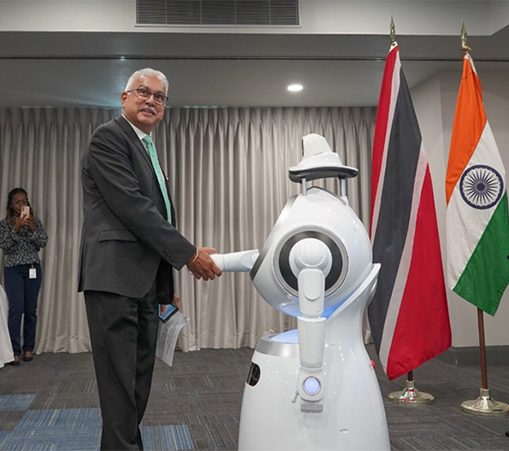
An Indian grant of $1 million has helped Trinidad and Tobago acquire eight mobile health service robots. The robots include two disinfecting units and six humanoid models. The disinfecting units sanitize high-touch surfaces in healthcare facilities, reducing COVID-19 transmission risks. The humanoid robots assist staff with patient interactions, data collection, and monitoring, easing workloads in busy hospitals. The project also features a telemedicine system, connecting healthcare workers to patients in remote areas via digital platforms designed with input from the University of Trinidad and Tobago.
The grant is part of the India-UNDP Fund, supporting the “Bringing High and Low Technology (HALT) to COVID-19” project. The equipment was handed over by the WHO Country Office to the Ministry of Health in Trinidad and Tobago. This initiative, rooted in India’s commitment to the Global South, addresses pandemic challenges with practical solutions.

India launched the India-United Nations Development Partnership Fund in 2017, partnering with the United Nations Office for South-South Cooperation (UNOSSC) to fund development projects. Trinidad and Tobago’s HALT project, which began in September 2021, builds on India’s earlier aid, including 500,000 AstraZeneca vaccine doses supplied to the Caribbean in 2020 and 2021. The telemedicine system, active since January 2025, has facilitated over 1,000 remote consultations in its first month, according to Ministry records.
The disinfecting robots now operate in four major hospitals, including Port of Spain General Hospital, where they have reduced sanitation times by 30%, according to early data. The humanoid robots support staff in tasks such as patient check-ins, freeing nurses for critical care. The telemedicine platform targets rural communities, reducing hospital visits and virus exposure risks— a priority for a country with dispersed populations.
India’s role extends beyond Trinidad and Tobago. In 2021, the fund provided $1 million for medical equipment in Belize, as part of over 50 projects worldwide. In Trinidad and Tobago, the HALT project strengthens pandemic response and offers a blueprint for resilience. The Ministry of Health plans a year-long review, with results due by December 2025, to assess impacts and guide future efforts. Through this collaboration with PAHO/WHO and local authorities, India’s investment delivers measurable support, blending high-tech tools with healthcare needs in Trinidad and Tobago.