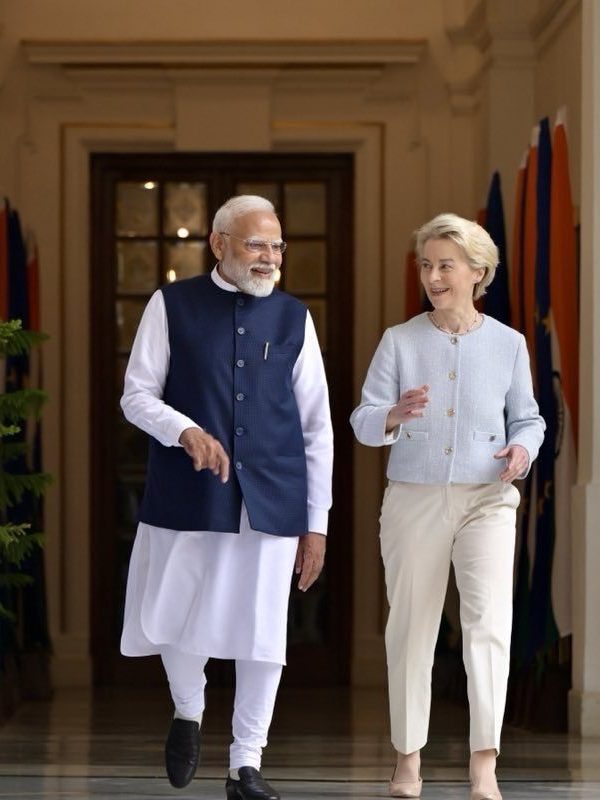
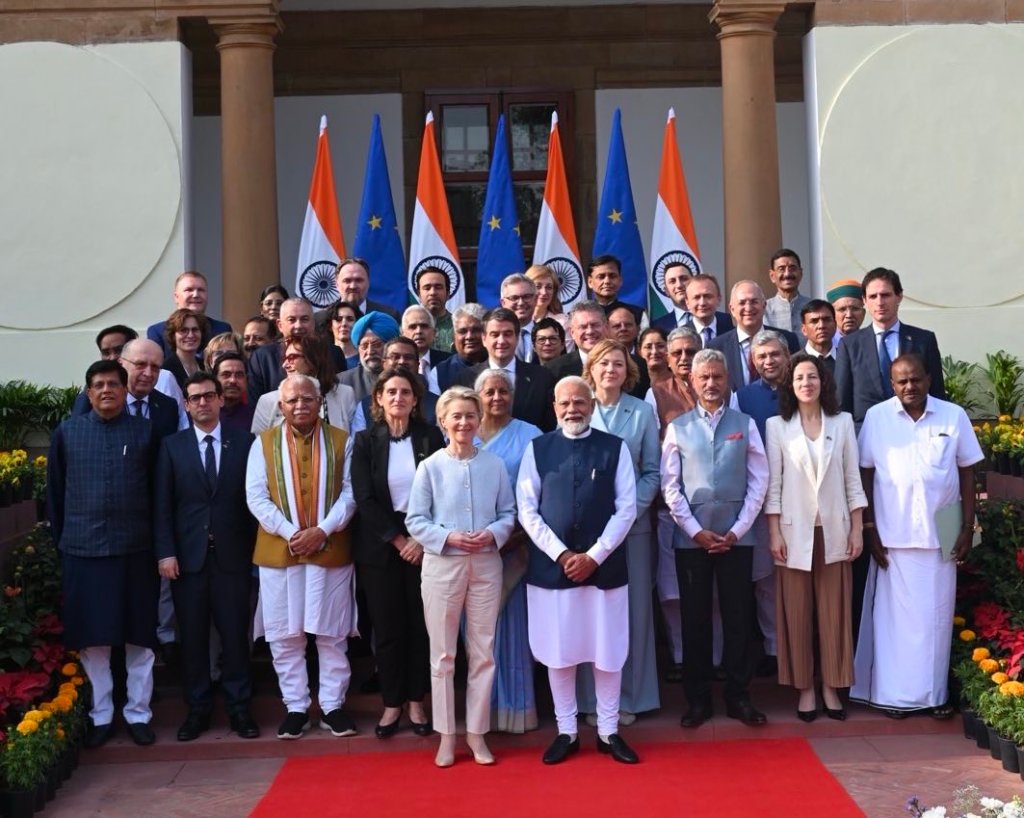
Prime Minister Narendra Modi and European Commission President Ursula Van der Leyen In New Delhi’s Hyderabad House on Friday
NEW DELHI: Prime Minister Narendra Modi and European Commission President Ursula von der Leyen wrapped up a landmark two-day summit on Friday, vowing to take India-EU Strategic Partnership to new heights. The meeting, held in New Delhi, marked the first visit by the European Union’s College of Commissioners outside Europe since their new mandate began and the first such engagement in the history of India-EU relations. The two sides discussed to wrap up the FTA by year-end, explore defence industry tie-ups, review IMEC progress, boost maritime awareness, and hold the next TTC meet soon. Green hydrogen talks and disaster management pacts were part of the high-level talk.
This two-decade long strategic partnership between India and EU is natural and organic. Its core is built on trust, a shared belief in democratic values, and a mutual commitment to prosperity and shared progress. In this spirit, we have held almost 20 ministerial level meetings of different sectors between yesterday and today.
Prime Minister Narendra Modi
The EU delegation, held talks with Indian ministers to hammer out long pending free trade agreement (FTA), with both sides directing negotiators to seal the deal by December 2025. The FTA aims to expand trade by easing market access and cutting barriers. Negotiations for a Free Trade Agreement (FTA) between the two sides relaunched in June 2022, after years of hiatus. The EU has been India’s largest trading partner with bilateral goods trade hitting $137.5 billion in 2023-24. The 27-member block, seeks steep cuts on duties exceeding 100% on automobiles, wines, and whiskey. Indian side has been apprehensive that a flood of European imports could hurt local manufacturers. On the other hand, India demands lower tariffs on textiles, garments, and leather exports and greater market access for its pharmaceuticals and chemicals, which face stringent EU regulations.
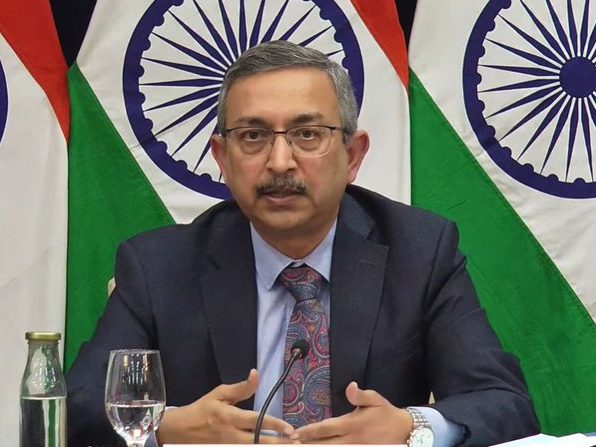
“Both sides have agreed that this is an important FTA. It has to be done quickly, and it has to be done in a balanced and a mutually beneficial and in a suitable manner.” Jaideep Mazumdar, Secretary East, Ministry of External Affairs
Prime Minister Narendra Modi and European Commissioner President Ursula Van der Leyen Led Delegation Level Talks In New Delhi’s Hyderabad House on Friday
Modi and Von der Leyen also backed the India-Middle East-Europe Economic Corridor (IMEC), unveiled at the 2023 G20 Summit, and pledged to fast-track it. The IMEC, backed by India, the United States, EU, Saudi Arabia, UAE, France, Germany, and Italy, comprises two corridors: the Eastern Corridor from India to the Arabian Gulf, and the Northern Corridor from the Gulf to Europe. It promises faster trade—up to 40% quicker than the Suez Canal route—through strings of ports like Mundra and Jawaharlal Nehru Port Trust in India, Fujairah and Jebel Ali in the UAE, Dammam in Saudi Arabia, Haifa in Israel, and Piraeus in Greece. Apart from the volatile security situation due to Israel Hamaz war, funding for this 4,800Km long multibillion dollar project also remains a challenge.
On the defence front, The EU welcomed India’s bid to join its Permanent Structured Cooperation (PESCO) projects and start talks on a Security of Information Agreement. Plans for a broader security and defence partnership, targeting terrorism and maritime safety, were also part of the broader discussion. In the Indo-Pacific, India welcomed EU joining the Indo Pacific Ocean Initiative (IPOI) and becoming an observer in the Indian Ocean Region Association (IORA) initiative.
The second ministerial meeting of the India-EU Trade and Technology Council (TTC), held during the visit, pushed cooperation in semiconductors, AI, and green tech. A key pact between the Bharat 6G Alliance and the EU’s 6G Smart Networks body was signed to secure telecom supply chains.
The leaders, in a joint statement, reaffirmed their commitment to democracy, rule of law, and a rules-based global order under the UN Charter. With trade, technology, and security at the forefront, India and the EU aim to counterbalance global uncertainties.